

In this guide, we’ll walk you through exactly what a prop firm evaluation is and how the entire process works from start to finish. You’ll discover what prop firms are looking for, how their challenge systems are structured, and whether this trading model aligns with your goals.
By the end, you’ll know precisely what it takes to pass an evaluation and start trading with simulated funds instead of your own money.
TLDR:
Prop firms let you trade with their money instead of your own. Here’s how it works: You pay a fee to enter an evaluation challenge where you need to hit a profit target (usually 8% in Phase 1, 5% in Phase 2) while staying within strict risk limits like a 5% daily loss cap and 10% maximum drawdown.
Pass both phases, and you get a funded account where you trade simulated funds and keep up to 90% of your profits.
The entire process is designed to prove you can manage risk and trade consistently. Once funded, you follow the same rules and get rewards every 14 days. For example, FundingRock uses a standard 2-phase evaluation (no instant funding, no hidden fees in spreads, and your FundingRock Account gets issued within 24 hours of passing). So if you want access to serious simulated funds without risking your own money, prop firm evaluations are your fastest route there is.
What Is A Prop Firm?
Prop firms are proprietary trading companies that allow individual traders to trade financial markets using the firm’s simulated funds instead of their own money. They exist to provide traders access to larger amounts of simulated funds than they could normally afford on their own. In return, the firm shares in any profits generated by the trader.
That said, prop firms are structured around risk control and performance. Their main purpose is to find skilled traders while protecting the company’s simulated funds.
How Does A Prop Firm Work?
Every prop firm has a slightly different process, but in practice, most of them work in very similar ways.
The process usually starts with the trader choosing an account size that matches their goals and trading style. After selecting an account, the trader enters an evaluation phase. During this stage, they must reach a specific profit target while strictly following the firm’s risk rules. The goal is to prove that they can be consistent, disciplined, and responsible with risk.
If the trader successfully passes the evaluation, they are granted a funded account. At this point, they are no longer trading their own money but instead using simulated funds provided by the firm.
How It Works Once You’re Funded
Once a trader receives a funded account, they trade simulated funds provided by the firm. They keep a portion of the profits they generate, while the firm keeps the rest. The exact reward share depends on the challenge model they completed, with multi-step models (like 2-step or 3-step) generally offering more favorable splits than instant funding options.
Important: Even after accounts are funded, the firm maintains strict trading rules. These usually include:
- A daily loss limit
- A maximum overall drawdown
- A risk limit per trade
The trader’s account is continuously monitored to ensure they stay within the limits. If they break them, they risk losing their funded account (these rules exist to protect the firm’s simulated funds).
Most prop firms offer regular rewards, typically on a weekly, biweekly, or monthly basis. Some firms allow traders to keep up to 90% of their profits, and reward processes are usually designed to be fast and transparent.
For example, with a $10,000 funded account that has a 3% daily loss limit, the trader can’t lose more than $300 in a single day. If their account drops by $300 or more in one day, they breach the rules and can lose their account. The idea is to encourage traders to stop trading well before they reach that limit, instead of pushing their luck.
Is A Prop Firm Right For Me?
A prop firm can be right for you if you want real trading experience with structure, support, and resources that help you define your skills. It may not be right if you prefer complete independence or do not want to trade under firm rules.
The right firm should fit your trading style, goals, and system. Look for firms that offer different challenge types for swing traders, scalpers, and other approaches. A firm that forces you into one rigid model that conflicts with your strategy is a red flag.
Clear and simple rules matter too. Some firms use technicalities like daily drawdown based on equity after profits or hidden lot size limits to catch traders out. You should always know exactly where you stand in a challenge, with no surprises.
Also, low spreads, fast execution, and fair commissions are just as important as reward splits. A firm might advertise no upfront fee while making money through high spreads or hidden costs. Higher trading costs reduce your profits and make challenges harder to pass.
How Does Prop Firm Evaluations Work For EU Traders?
Most prop trading firms offer two types of challenges, and each one tests your skills and risk management abilities differently. Here’s how they typically work:
Phase 1 Challenge:
Phase 1 is the main evaluation step where traders need to reach a clear profit target while staying inside firm risk limits. The idea is to show you can make money without breaching daily or overall drawdown rules, which is similar to how most 2 step challenges structure their first phase with a target around 8%.
For example, to pass FundingRock’s Phase 1, you need an 8% profit on your starting balance, at least 4 trading days, and you must stay within a 10% maximum loss and a 5% daily drawdown. Once you meet these conditions, your Phase 2 credentials are issued within 24 hours.
Phase 2 Challenge:
Phase 2 is a verification phase that tests whether you can repeat your performance with a smaller profit target and the same risk controls. Most firms design this step to prioritize consistency instead of one strong winning period.
To pass FundingRock’s phase 2, you need a 5% profit on your starting balance, at least 4 trading days, and you must keep losses within the 10% maximum and 5% daily drawdown limits. After completing this, you receive your FundingRock Account within 24 hours.
Phase 3 Challenge:
Phase 3 is a less common and longer evaluation route that adds an extra consistency check before funding. Each step usually requires about a 6% profit while keeping standard drawdown limits. The slower structure makes it more suitable for traders who prefer gradual validation of their strategy before managing simulated funds.
Instant Funding (No Challenge):
Some prop firms offer immediate funded accounts, which means traders can start trading a funded balance right away without completing a standard evaluation first. However, instant funding typically comes with tighter risk limits, higher fees, or shorter probation periods so firms can manage their risk.
FundingRock takes a different approach and doesn’t offer instant funded account challenges. All traders must complete a two-phase evaluation process before receiving a FundingRock Account to maintain fair trading and proper risk management.
How FundingRock Evaluate’s A Trader’s Success
FundingRock evaluates a trader’s success through three main requirements. Traders…
- Must reach a specific profit target based on their challenge account.
- Must stay within daily and overall loss limits to show responsible risk management.
- Need to complete their required minimum number of trading days.
Traders must successfully finish all phases of the challenge to be considered successful. Once completed, the Trade Team reviews their performance to make sure all rules were followed. If the review is satisfactory, the trader is offered a FundingRock Account.
All trading during the challenge takes place on a demo account. Withdrawals are only available after becoming a Funded Trader and completing every phase of the process.
How Can I Get Started With FundingRock?
Here’s how to get started with FundingRock:
1. Sign up
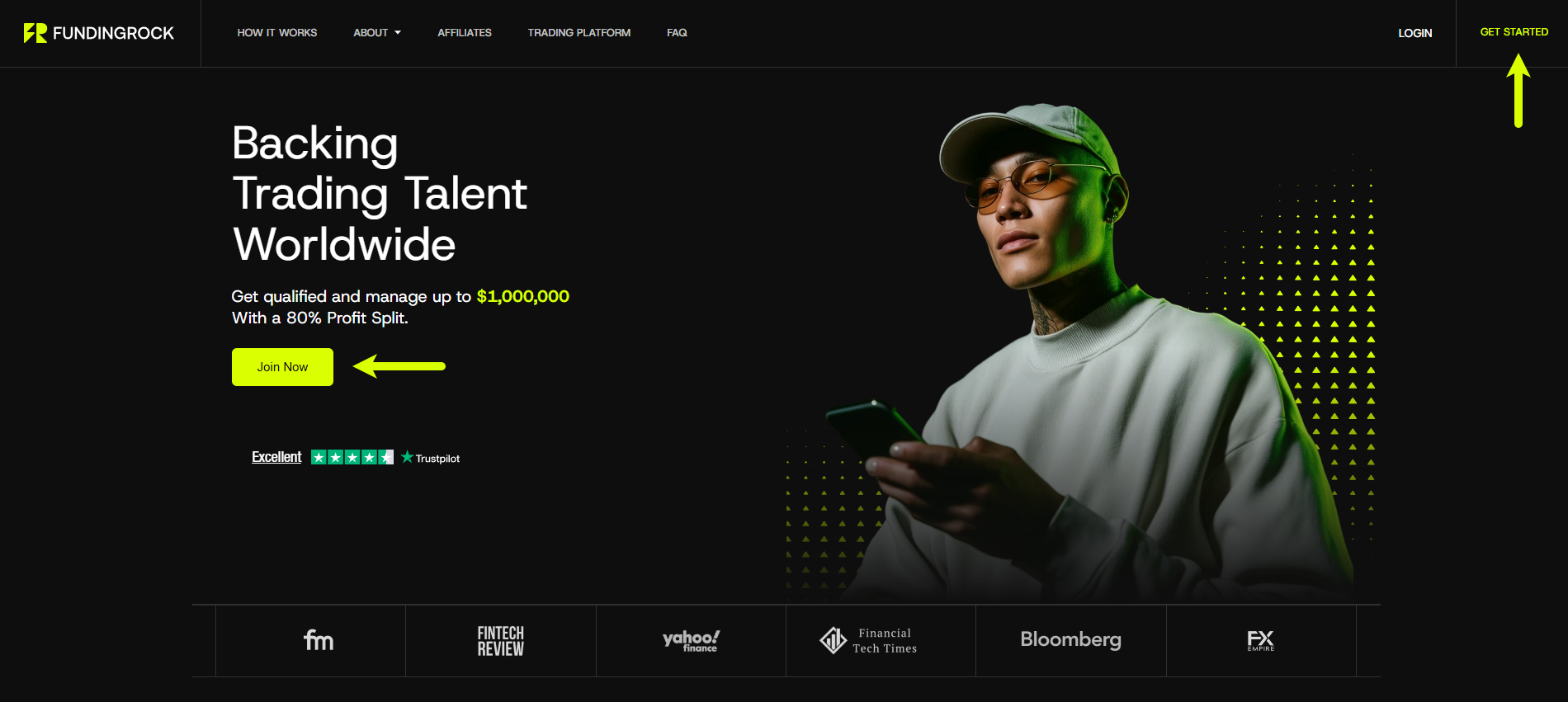
Click the “Join Now” or “Get started” button on the homepage and create your account. Provide basic information and set your username and password.
2. Pick your challenge
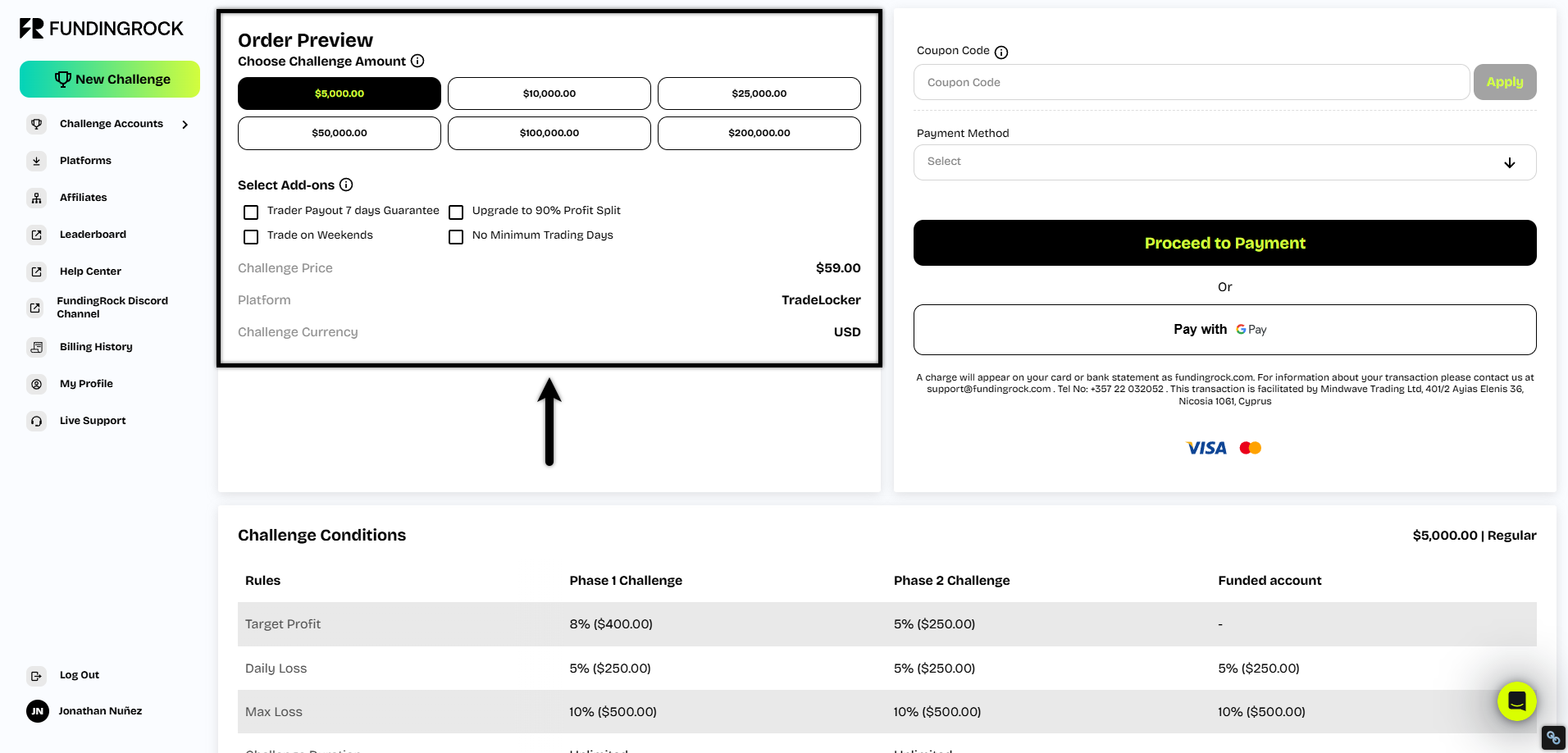
Choose a challenge that matches your trading style.
3. Trade and prove yourself
Trade according to your selected challenge. Hit the profit target while staying within all risk rules.
4. Get funded
Pass both phases of the challenge to receive a FundingRock Account
5. Withdraw your profits
Request a reward every 14 days. FundingRock will process your withdrawal.
That’s it. That is the complete process to start trading with FundingRock, so what are you waiting for? Create your account right now to access your challenge account.
Conclusion
Prop firm evaluations are built to identify traders who can manage risk, follow a system, and generate consistent returns. The process is straightforward: prove you can hit profit targets while respecting drawdown limits, and you’ll gain access to simulated funds you could never trade with on your own.
FundingRock’s evaluation system removes the guesswork. You know exactly what’s required at each phase, from the 8% Phase 1 target to the 5% Phase 2 verification. There are no hidden fees buried in spreads, no arbitrary rule changes, and no delays when you’re ready for a reward. Pass both phases, and your FundingRock Account is issued within 24 hours.
If you’re serious about trading but lack the simulated funds to make it worthwhile, a prop firm evaluation is your fastest route to professional-level funding. So go ahead and create your FundingRock account today and start your Phase 1 challenge.