

How To Buy A Prop Trade Challenge Account
Buying a prop trade challenge account is one of the fastest ways to access significant trading capital, but it comes with some financial risk. Challenge fees can range from a few hundred to several thousand dollars, and most evaluations impose strict daily loss limits, maximum drawdown thresholds, and profit targets that must be hit within specific timeframes. One wrong move and you lose both your fee and your shot at funding.
That’s why traders must pay close attention to the firm they work with. Not every prop firm operates fairly, and the differences in rules, payout structures, and risk parameters can determine whether you succeed or fail before you even place your first trade.
In this guide, we’ll walk you through how to choose a reputable prop firm, break down the three main challenge types, and show you exactly how to get started with a firm that offers clear rules and real opportunity.
TLDR:
Prop trade challenges give you access to serious capital, but they can cost hundreds or thousands of dollars (and one blown trade can wipe out your fee and your shot at funding). So choose wisely.
What to look for in a firm:
Transparent rules, fair pricing, reliable payouts, solid reviews, and great support.
There are three challenge types that exist:
- 1-step evaluations are fast and simple but come with tight risk limits and short timeframes (best for aggressive, experienced traders).
- 2-step evaluations take longer and test consistency across two phases (better for conservative traders and swing strategies).
- Instant funding skips the evaluation entirely but costs more and often comes with stricter drawdown rules (ideal if you want immediate market access).
The bottom line:
Match the challenge type to your trading style, research the firm before you pay, and don’t rush into anything.
Why Choose A Reputable Prop Firm
Not all firms operate the same way or offer fair conditions. Rules, payout structures, challenge formats, and risk parameters can vary widely, and lower-quality firms often impose restrictions that make consistent profitability difficult.
Here’s what you should look for when choosing a prop firm to work with:
- Clearly explains drawdown limits, profit splits, allowed instruments, and challenge fees.
- Pricing should be reasonable in relation to the funding offered, trading conditions, and payout system, especially since most firms charge an upfront payment.
- Look for fast and straightforward payouts with different withdrawal options.
- Consider trader reviews and testimonials to verify payout reliability and overall trustworthiness.
- Check if there’s strong customer support and access to educational resources. Those are additional indicators that a firm is committed to supporting traders.
Select Your Challenge Type
Prop firms offer three main funding models: 1-step evaluations, 2-step evaluations, and instant funding (not always).
Each model comes with its own rules, timelines, and risks. That’s why you must understand the differences between them to match your trading style to the structure most likely to work in your favor.
1-Step Evaluation:
A 1-step evaluation is a single-stage trading challenge where traders must reach an 8-10% profit target on a simulated account and respect strict risk limits. The maximum daily loss is 4% and the maximum overall drawdown is 6%. The evaluation runs within a set timeframe and can be completed in as little as one trade.
The main advantage offered here is speed. Faster access to funding and simple, clearly defined rules allow traders to focus on execution instead of managing multiple stages. Plus, lower profit targets and a static drawdown make the evaluation easier to follow.
The main disadvantage, however, is pressure. Tight risk limits and short timeframes can encourage rushed decisions and overtrading. Also, long-term consistency and adaptability to changing market conditions are not strongly assessed.
A 1-step evaluation is best for experienced, aggressive traders who prefer simplicity, manage risk tightly, and perform well under short-term pressure.
2-Step Evaluation:
A 2-step evaluation is a structured trading challenge that allows prop firms to decide whether a trader qualifies for funding. The process is split into two phases that must be passed in order.
- Phase 1 focuses on reaching a profit target of about 5-8% under standard risk limits.
- Phase 2 lowers the profit target to around 4-5% and applies tighter rules to confirm consistency.
For example, FundingRock offers a 2-step evaluation with specific rules like this: On a $200,000 account, Phase 1 requires an 8% profit target of $16,000, with a 5% daily loss limit of $10,000 and a 10% maximum loss of $20,000. Phase 2 requires a 5% profit target of $10,000 under the same loss limits. When you pass both phases you get a funded account.
Now, the main advantage of a 2-step evaluation is that it provides a deeper and more balanced assessment of a trader’s skill. This structure rewards consistency over quick wins and pushes traders to refine risk management and execution. And wider drawdown limits after passing also give funded traders more room to operate.
The biggest drawback, however, is the longer path to funding. Added rules in Phase 2 can increase pressure and limit flexibility, which often lowers pass rates. A higher time commitment and evaluation cost make the model less attractive for traders looking for fast results.
A 2-step evaluation works best for conservative traders who prefer a steady, methodical approach. Swing traders using wider stop losses often find this structure more comfortable.
Instant Funding:
Instant funding is a prop firm model where traders receive a funded account immediately without completing a 1-step or 2-step evaluation. Capital is available from day one, and profits can be withdrawn once the firm’s payout rules are met.
The main advantage is immediate access to trading capital without pressure of passing evaluation phases. Traders can trade more conservatively since there is no need to hit high profit targets to qualify for funding. Faster access to capital allows quick reactions to market opportunities, including nights and weekends, and provides more flexibility since trading is not limited by a personal balance.
The drawbacks are higher costs compared to traditional challenges and stricter risk structures. Some of the disadvantages are trailing drawdowns that move upward as profits increase, which can be more restrictive than static drawdowns. Some firms limit profit withdrawals in the early stages, reducing short-term cash flow.
Instant funding works best for experienced traders who want immediate market access and prefer avoiding evaluation phases.
Choosing FundingRock As Your Prop Firm
FundingRock is a proprietary trading firm that provides traders with access to funded accounts through structured evaluation programs. Skilled traders prove consistency and risk control by completing trading challenges before receiving capital.
It’s an attractive option because it offers clear trading rules, defined risk parameters, and funding challenges reaching up to $200,000.
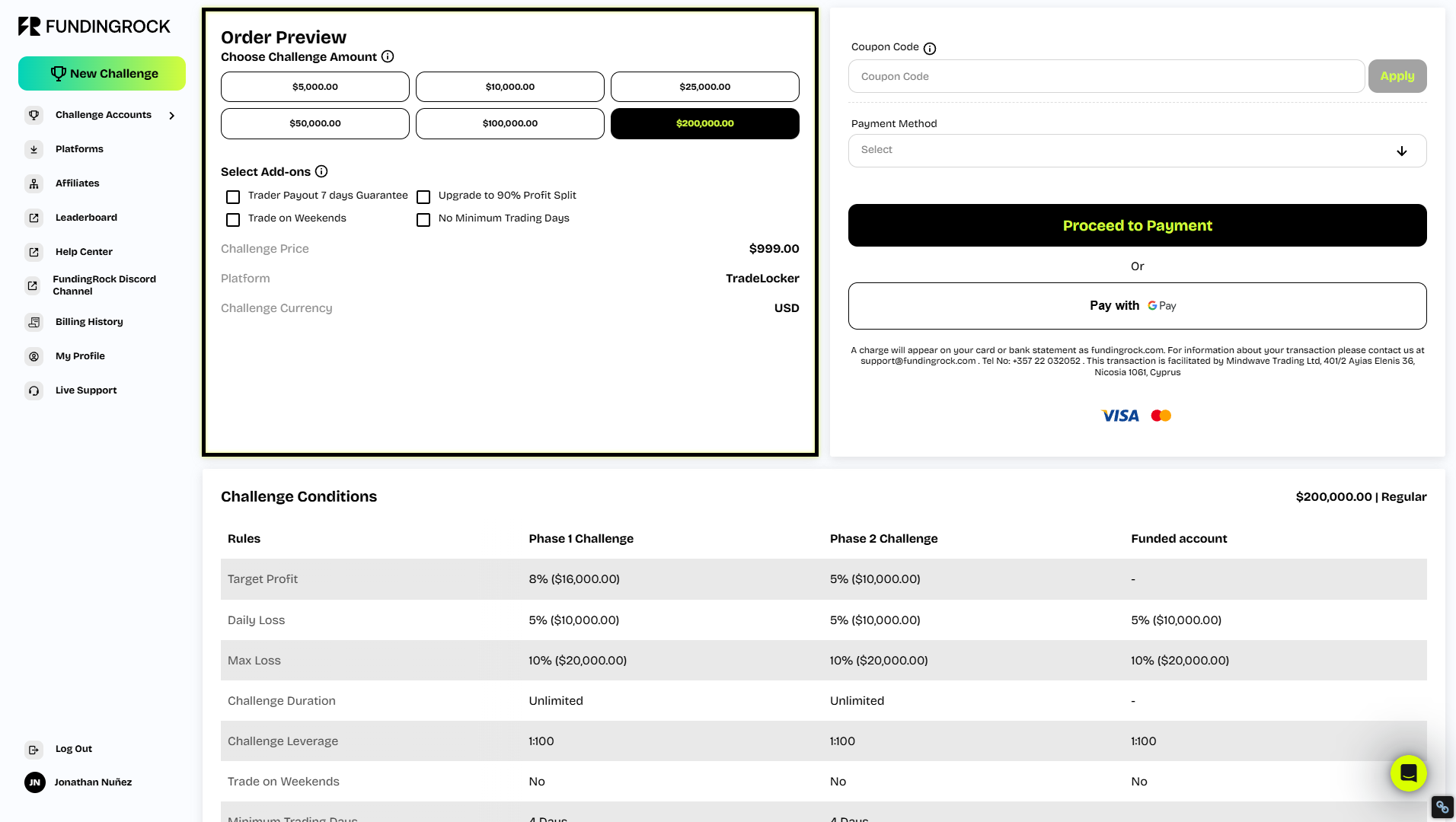
Moreover, it gives access to large capital so traders scale without risking personal funds. On top of that, defined profit targets and strict drawdown limits promote disciplined and professional trading behavior.
Also, educational tools and a supportive community help traders improve performance over time. Lastly, multiple challenge sizes make the firm suitable for traders at different experience levels.
That said, trading in FundingRock is straightforward. It’s part of the 2-step evaluation system. Phase 1 requires an 8% profit target, followed by Phase 2 with a 5% profit target. Each phase includes a 5% maximum daily loss, a 10% maximum total loss, and a minimum of 4 training days.
FundingRock offers $5,000, $10,000, $25,000, $50,000, $100,000, and $200,000 trading challenges. All challenges follow the same rules, making the evaluation process clear and consistent across account sizes.
How To Register And Get Started With FundingRock
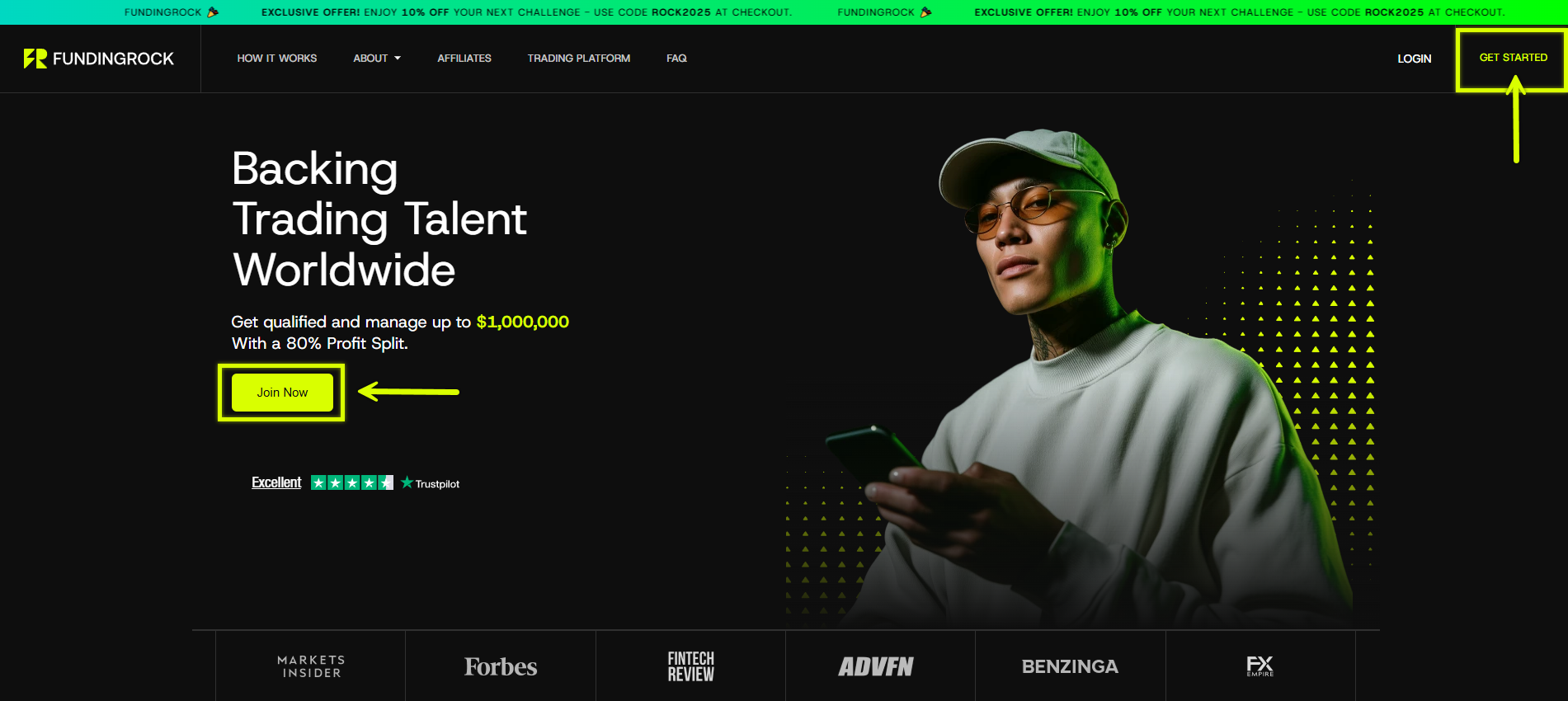
- Visit the FundingRock homepage and click “Join Now” or “Get Started.”
-
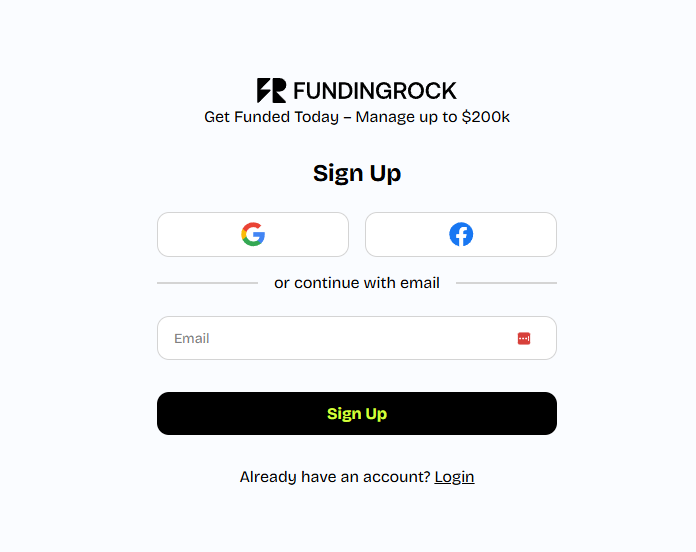
Create your account using one of the following options:
- Email: Enter your email address, then set your username and password.
- Google sign-on: Register instantly using your Google account.
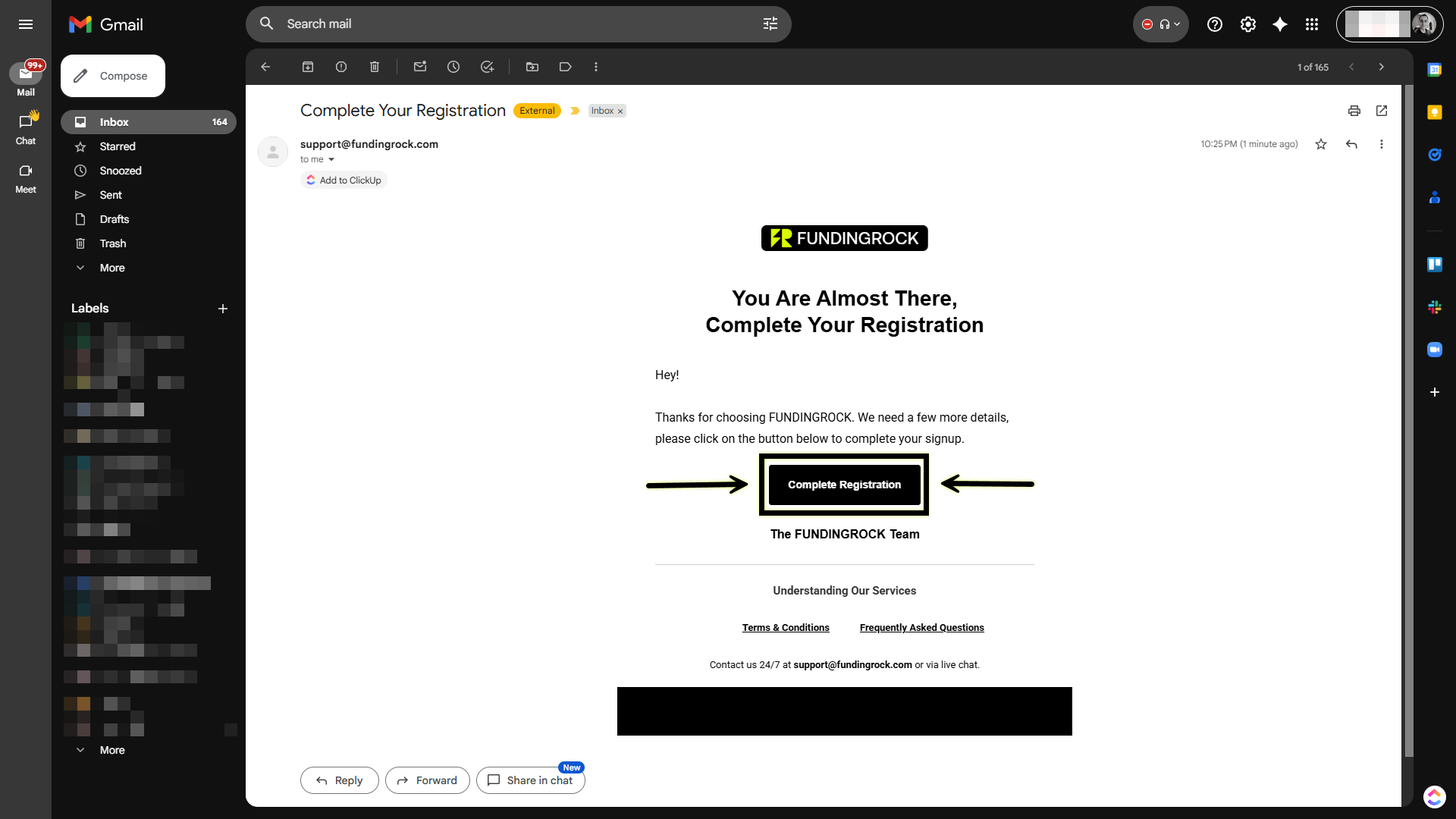
- Open your Gmail inbox and confirm your account by clicking Complete Registration in the verification email.
- After confirmation, access the FundingRock dashboard and choose an evaluation account that fits your goals. Challenge sizes range from smaller accounts to larger options like the $200,000 challenge.
- Go to the Challenges section inside the dashboard and click “New Challenge” in the top-left corner.
- Enter the trading account with one click and start trading. Reach the profit target: maximum daily loss, total drawdown, and minimum trading days.
And that’s it! It’s just that easy to start your trading journey.
Conclusion
Buying a prop trade challenge account should be a strategic decision. The firm you choose, the challenge type you select, and the rules you agree to all shape your path to funded trading.
Reputable firms offer transparent drawdown limits, fair profit splits, and reliable payouts (lower-quality firms stack the odds against you with hidden restrictions and unclear terms). This difference matters, and it starts with doing your research before spending a single dollar.
So whether you opt for the speed of a 1-step evaluation, the structured consistency of a 2-step process, or the immediate access of instant funding, consider your trading style, match it to the right challenge, and give yourself the best chance of success.